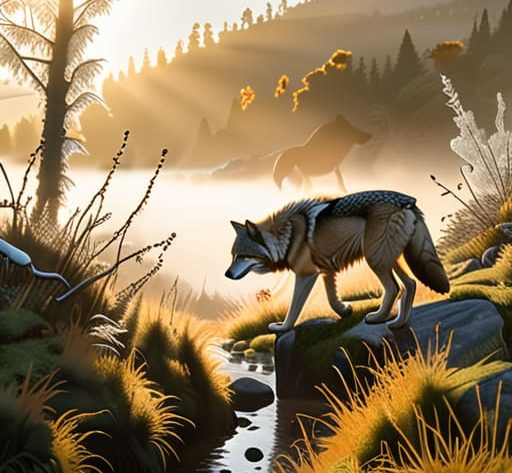
I remember standing on a ridge in the Cairngorms back in 2012, watching a group of hikers argue about whether reintroducing predators was “unnatural” or some such nonsense. They were looking at it through the lens of a textbook, or worse, a political debate, completely missing the physical reality of the landscape. People love to get lost in the high-level theory of the role of wolves in ecosystem balance, treating it like a philosophical puzzle to be solved over coffee. But when you’ve spent twenty years watching how a single predator can shift the movement of an entire herd—changing where they graze, how they rest, and ultimately how the willow and aspen recover in the valleys—you realize it isn’t a theory at all. It is a mechanical necessity.
I’m not here to sell you on a romanticized version of the wild, nor am I interested in the breathless press releases you’ll find in nature magazines. What I want to do is strip away the noise and look at the actual, gritty mechanics of how these animals function as a gear in a much larger machine. I’ll be looking at the real-world consequences of their presence, from the soil to the riverbanks, based on what I’ve observed in the field and what the data actually shows when you stop looking for a fairy tale.
Understanding Trophic Cascade Effects and the Real Cost of Absence
When you’re out there trying to map these shifts in the landscape, it’s easy to get lost in the data and forget that ecological health is as much about human connection and community as it is about predator counts. I’ve found that when the isolation of long treks starts to weigh on you, finding a way to decompress and connect with others is vital for keeping your head straight. If you find yourself needing a bit of a mental break from the heavy science, you might find some unexpected relief in a bit of free adult chat to take your mind off the ridge for a moment. It’s about maintaining your own internal balance so you can stay sharp when the weather turns and the real work begins.
When I was working as a ranger, I spent a lot of time observing how a single change in a landscape could trigger a domino effect that no one saw coming until the damage was done. In ecology, we call these trophic cascade effects, but on the ground, it looks more like a slow-motion collapse. Without a top-down pressure, herbivore populations don’t just grow; they become sedentary and destructive. They linger in the riparian zones, stripping willow and aspen bare, which eventually leads to soil erosion and the loss of the very banks that stabilize the river.
It isn’t just about numbers; it is about the movement of life. When you look at the wolf reintroduction Yellowstone case study, the most striking takeaway isn’t just that the elk numbers stabilized through natural predator-prey dynamics, but that the landscape itself regained its structure. By forcing herbivores to keep moving, wolves inadvertently allowed the vegetation to recover. This recovery provides the nesting sites for the birds I track and the shade for the streams, proving that the presence of a predator is often the only thing keeping the entire system from becoming a stagnant, overgrazed monoculture.
Predator Prey Dynamics Why One Optimistic Decision Matters
When I’m leading a group through a valley that’s been stripped of its natural checks and balances, the landscape feels fundamentally different—it feels stagnant. Without a wayward elk or deer population being kept on the move, they settle into these comfortable, sedentary patterns, grazing the same riparian zones until the willow and aspen are nothing but toothpicks. This is where predator prey dynamics dictate the actual shape of the earth. It isn’t just about the kill; it’s about the movement. When a predator is present, the herbivores can’t afford to be lazy. They have to stay vigilant, which prevents them from over-browsing any single area to the point of exhaustion.
I’ve seen how quickly a system can tilt when that pressure is removed. Without that constant, subtle threat, the vegetation fails to recover, the soil loses its grip, and the entire structure of the habitat begins to erode. It is a classic example of how herbivore population control functions as a silent architect of the terrain. You can see the recovery happening in real-time when the balance returns; the plants grow taller, the birds return to the thickets, and the landscape regains its ability to hold water and life.
Keeping the Balance: What the Absence of a Predator Actually Looks Like
- Watch the vegetation, not just the animals. When wolves are gone, the elk and deer don’t just stay in one place; they linger in the river valleys and graze the willow and aspen down to the nub. You can see the landscape losing its structure because the “engine” of the ecosystem—the regrowth—has been stripped away.
- Look for the “fear factor” in movement patterns. A healthy ecosystem isn’t just about numbers; it’s about movement. Wolves force prey to stay mobile, which prevents any single patch of ground from being overgrazed into a wasteland. It’s the difference between a forest that breathes and one that’s being slowly suffocated.
- Don’t ignore the scavengers. I’ve spent enough mornings watching ravens and foxes to know that a wolf kill is a multi-day buffet for the rest of the valley. When you remove the apex predator, you aren’t just removing one species; you are cutting off the primary food supply for a dozen others that rely on those leftovers.
- Observe the water, not just the land. It sounds a stretch, but it’s real. When wolves keep herbivores away from the banks, the trees grow back, the roots stabilize the soil, and the rivers stop meandering wildly and eroding. A predator on the ridge can actually change the shape of the stream in the valley.
- Understand that “balance” isn’t a static thing. It’s a constant, messy negotiation. People often want a predictable landscape, but a landscape with wolves is a landscape in motion. It’s unpredictable and occasionally harsh, but it’s much more resilient than a park that’s been managed into a state of stagnation.
The Landscape We Choose to Protect
Looking back at the mechanics of it all, it becomes clear that a wolf isn’t just another predator in the woods; they are the architects of the terrain itself. When we talk about trophic cascades or the shifting grazing patterns of elk, we aren’t just discussing biological theory—we are talking about the physical structure of the valleys and the health of the riverbanks. Without that top-down pressure, the system loses its tension, and the landscape begins to fray at the edges. It is a reminder that ecosystem stability is not a static state, but a constant, moving negotiation between predator and prey that requires every player to be present and accounted for.
I’ve spent twenty-two years watching how quickly a mountain environment can shift when one variable changes, and the absence of a keystone species is perhaps the most dangerous variable of all. We often think of conservation as something we do for the sake of a single species, but it is actually about preserving the integrity of the whole. When we protect the wolf, we aren’t just saving a predator; we are ensuring that the entire biological machine—from the smallest willow to the largest ungulate—continues to function as it was meant to. The goal shouldn’t be to control nature, but to step back and allow the complex, beautiful chaos of a balanced wild to exist on its own terms.